

The short version
- Describe the questions and tasks the assistant needs to handle.
- Understand the information each task uses and where it can be processed.
- Compare the full cost of running and supporting the workload.
- Test the proposed setup with the people who will use it.
A team wants an assistant that can answer questions from its manuals. Another wants help writing code. Both are asking for AI, but the information they use and the way they work may lead to different deployment choices.
Start with the work rather than a preference for a particular model. Consider where the information can be processed, how often people will use the assistant and who will support it. Private, cloud and mixed deployments each have a place when those requirements are clear.
Choose where AI runs around the work it does.
Answer these questions together before choosing a deployment.
 OpenAI
 Claude
 Gemini
 DeepSeek
 Qwen
QwenCloud
Use a model hosted by an external provider.
Cloud provider examplesHybrid
Choose where each workload runs.
A mix of cloud and local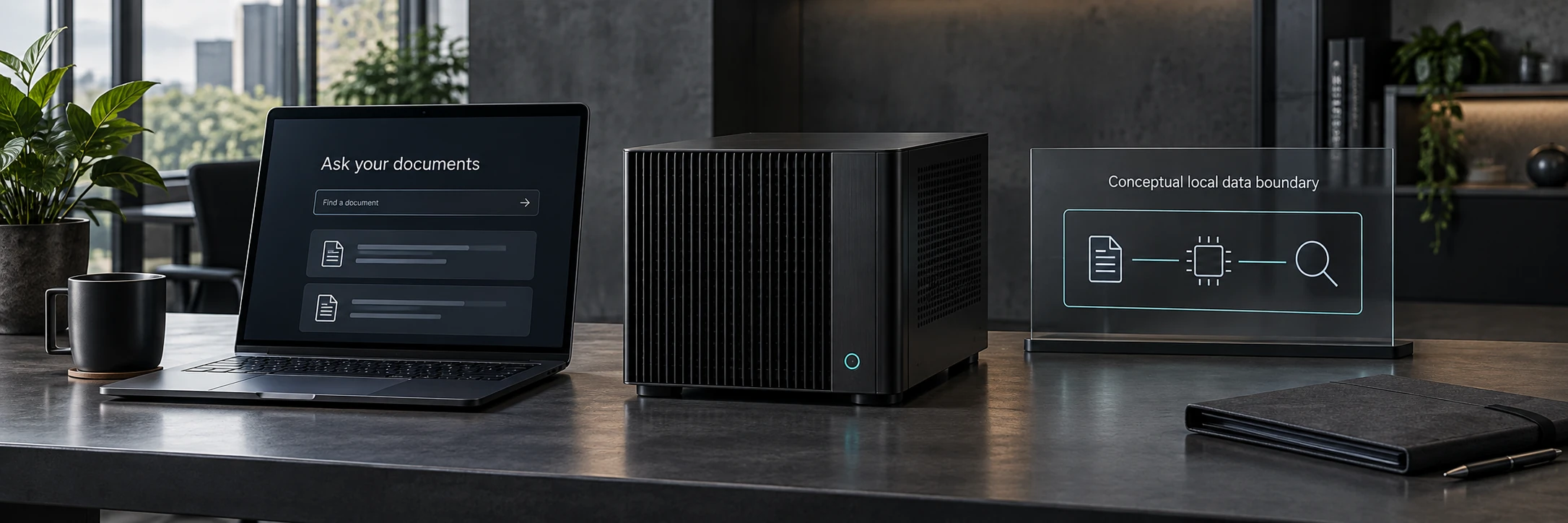
Private AI
Run a locally deployable model in your own environment.
On-site or dedicated hostingThe questions behind the choice
What is the data?
Its sensitivity, residency needs and which information may leave your environment.
What must you meet?
Legal requirements, customer contracts, audit needs and approval duties.
What can you operate?
The workload, response time, infrastructure, support and full running cost.
Record the reasons for the choice, including who will run and support it.
Cloud
An external provider runs the model.
For workloads suited to external processing.
Hybrid
Different tasks run in different places.
Set the boundary for each workload.
Private
The model runs in your environment.
For local control or offline operation.
Question one: what information may leave the environment?
Start by classifying what the application will send to the model. This may include prompts, retrieved documents, database results, user identities, conversation history and generated answers. The fact that a production database remains isolated does not mean all approved context stays local.
A cloud application may query an isolated analytics store, select a small result and send that result to a hosted model. Production is protected, but the selected context crosses the client boundary. That can be acceptable when the provider, contract, retention policy, region and approved data classes meet the client's requirements.
Private AI keeps inference inside the client environment. Prompts, retrieved context and outputs remain local when the surrounding dependencies are local too. A deployment described as offline must also remove internet-dependent authentication, telemetry, fonts, monitoring, licence checks and updates. Running the model locally while another component calls home is not an offline system.
Database isolation and data residency answer different questions.
One keeps the model away from production. The other controls where approved prompts, context and answers are processed.
Question two: what must the application do under real conditions?
Model benchmarks are a poor substitute for a workload. List the tasks the application must complete, the languages it must handle, the response time users will accept and what should happen when the internet or model is unavailable.
Cloud models often offer broad capability, rapid updates and elastic capacity without local accelerator hardware. They fit teams that need strong general reasoning, variable usage or quick access to new model features, provided the approved data can cross the boundary.
Private AI fits work that must stay local, continue during an external outage or operate near a data source with predictable demand. It can also give the client more control over model versions and change timing. The trade-off is that local capacity is finite. A model that fits the hardware may not match the capability of a large hosted service on every task.
Hybrid design is often the honest answer. A local model can handle sensitive document search or routine extraction, while an approved cloud model handles a separate task that needs broader reasoning. The application decides which route is allowed for each data class and use case.

Question three: who will own the service after launch?
Cloud pricing is visible on a usage line, but it is not the whole cost. The application still needs identity, access controls, logging, evaluation, monitoring and incident handling. Private AI avoids per-request model fees, but it adds hardware capacity, power, cooling, patching, model management and recovery planning.
The ownership question is practical. Who watches capacity? Who approves a model update? Who checks that a new version still answers known questions correctly? Who restores the service after a hardware failure? If those responsibilities do not have names, the operating model is incomplete.
| Decision area | Cloud AI tends to fit when | Private AI tends to fit when |
|---|---|---|
| Data boundary | Approved context may reach the provider under agreed controls | Prompts, context and outputs must stay local |
| Capability | The task benefits from leading general models and frequent updates | A tested local model meets the defined workload |
| Demand | Usage varies and elastic capacity matters | Demand is predictable and local capacity can be sized |
| Connectivity | The service can depend on a reliable external connection | The application must continue locally or offline |
| Operations | The team prefers a managed model service | The client wants and can support direct operational control |
Hybrid is a policy decision, not a compromise label
A hybrid architecture is useful only when the routing rule is clear. "Use local where possible" is too vague. The application needs a policy that maps data classes and tasks to an approved inference route.
For example, an internal document assistant may keep retrieved document passages on premises. A separate marketing-writing tool may use a hosted model because its inputs contain no restricted data. Users should see which mode they are using, and the system should prevent a restricted task from silently falling back to cloud inference.
This policy should live in application controls, not only in user training. People under time pressure will choose the path that works. The design must make the approved path the easy one.
Compare cost over the same period and service level
A fair comparison uses the same workload, availability target and support boundary. For cloud AI, estimate request volume, prompt and output size, retrieval costs, data transfer and growth. For Private AI, include hardware, redundancy, power, support time, model updates, monitoring and replacement.
Then test uncertainty. What happens if usage triples? What happens if the local model needs larger hardware to meet the accuracy target? What happens if a hosted provider changes a model or price? The best option is the one the company can operate and budget with acceptable risk, not the one with the lowest first-month estimate.
Run a decision proof before a platform rollout
- Choose two or three real tasks with approved sample data.
- Define the data boundary and the expected answer quality for each task.
- Test one suitable cloud model and one feasible local model.
- Measure answer quality, response time, failure handling and operating effort.
- Record which tasks fit cloud, local or both.
- Build the routing and audit rules around that evidence.
This proof prevents a broad infrastructure decision from being made around a generic chatbot demo. It also shows where a mixed design earns its complexity and where one route is enough.
The executive decision worksheet
- Which data classes may be sent outside the client environment?
- Must the service continue when the external connection is unavailable?
- Which real tasks must the selected model pass?
- What response time and concurrent usage must the system support?
- Who owns model updates, evaluation, capacity and recovery?
- What is the three-year cost under expected and high usage?
- Does a hybrid route solve a real boundary difference or merely postpone the decision?
Choose the boundary before choosing the model
Tell us what the application needs to do, what data it will handle and how your team wants to operate it. NexLink can test the cloud, local and hybrid paths against the same workload.
This draft provides a decision framework, not a blanket recommendation. The correct deployment depends on the client's data policy, workload and operating responsibilities.